 Ultimate guide
A Guide to Spiritual Legacy Research for Black Families
Last Updated: November 5, 2026
Quick Summary
Spiritual legacy research for black families means tracing how faith, worship, and ancestral belief passed between generations, then recording what you find so it survives. Begin with three generations you can name from memory and work backward one generation at a time, interviewing the oldest living relative first.
- Begin with three generations you can name from memory, then work backward one generation at a time.
- The 1870 federal census is the first to list formerly enslaved people by name, so treat it as your anchor.
- Search Freedmen's Bureau records from 1865 to 1872 for marriage registers and labor contracts.
- Confirm a name match with at least two independent details before attaching a person to your tree.
- Scan prints at 600 dpi and slides or negatives at 1200 dpi, keeping the originals.
Table of Contents
- Why Spiritual Legacy Research Matters for Black Families
- African American Genealogy Research: Where to Begin
- Family Oral History Interview Questions That Open Doors
- Documenting African American Spiritual Practices Across Generations
- Hoodoo vs. Voodoo: Understanding the Distinction
- Researching Ancestors When Slavery and Migration Obscure the Record
- Building a Family Spiritual-Legacy Archive
- Start Your Own Spiritual Legacy Research With June Conway
- Frequently Asked Questions
Why Spiritual Legacy Research Matters for Black Families
Spiritual legacy research for black families is the practice of tracing how faith, worship, and ancestral belief passed from one generation to the next, then recording what you find so it survives.
The stakes are practical. Records go missing, elders pass on, and stories that lived in one person's memory disappear with them. Research closes that gap before it widens.
- It anchors identity in documented evidence rather than guesswork.
- It gives children a named inheritance instead of a vague sense of heritage.
- It preserves practices that were never written down anywhere official.
African American Genealogy Research: Where to Begin
Begin with three generations you can name from memory, then work backward one generation at a time. Skipping ahead to a famous ancestor or a distant continent usually stalls the work.
Starting With What Your Family Already Knows
Write down every full name, nickname, birth year, county, and church you can recall. Nicknames matter more than most beginners expect, because a woman recorded as "Sis. Hattie" in a church program may appear as "Harriet" on a death certificate.
Interview the oldest living relative first. Ask what they were told, not what they can prove.
Working Through Records When Names Change
Names shift for ordinary reasons: remarriage, migration, literacy gaps in record-taking, and the plain fact that enslaved people were often listed by first name only. Track people by household groupings, ages, and locations when surnames fail you.
For a deeper framework on tracing biblical lines alongside family lines, our guide on how to study biblical genealogy effectively walks through the method step by step.
Family Oral History Interview Questions That Open Doors
The best oral history questions ask for scenes, not summaries. "Tell me about your grandmother" gets a shrug. "What did her kitchen smell like on a Sunday morning?" gets an hour.
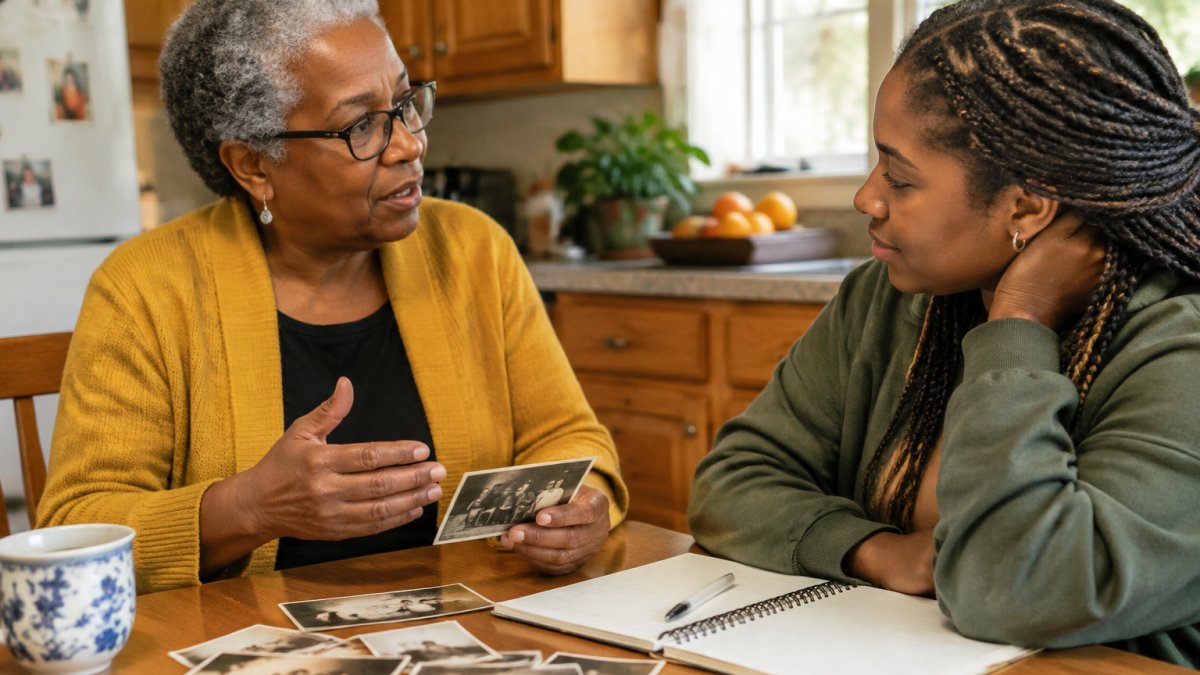
Try these openers:
- Who was the praying person in your family, and where did they pray?
- What songs did your church sing that you never heard anywhere else?
- What did your family do when someone was sick and medicine ran short?
Record with permission, and note the date and the speaker's name on every file. Our free teaching resources include discussion guides you can use to structure a group interview session.
Documenting African American Spiritual Practices Across Generations
Document practices the way an archivist would: date, place, person, and source. A prayer tradition remembered by three cousins is stronger evidence than one cousin's memory alone.
Common threads families document include prayer circles, home devotionals, watch night services, burial customs, and the songs and scripture verses that traveled between congregations.
A guided journal helps here because it prompts the same questions across branches of the family, which makes comparison possible later. Our spiritual lineage Bible study journal guide shows how to lay out those entries.
Hoodoo vs. Voodoo: Understanding the Distinction
Hoodoo and Voodoo are not the same tradition, and the difference matters when you are documenting what an ancestor actually practiced.
Hoodoo is a set of African American folk spiritual practices focused on practical matters: protection, healing, luck, and justice.
Voodoo, more properly Vodou, is a structured religion with ordained priesthood, named deities, and organized ceremonies, rooted in West African traditions and carried into Louisiana and the Caribbean.
Families often find both in the same lineage, and neither should be treated as embarrassing folklore.
Researching Ancestors When Slavery and Migration Obscure the Record
This is the hard part, and most guides skip it. Enslaved ancestors frequently appear in property inventories, bills of sale, and plantation ledgers rather than in birth records, which means the researcher has to read documents created to treat people as assets. The goal is not to find one dramatic document but to build a chain of evidence strong enough that a skeptical relative, or a future researcher, can follow it.
The 1870 Wall and How to Cross It
The 1870 federal census is the first to list formerly enslaved people by name, with household members, ages, and birthplaces. Treat it as your anchor, not your finish line. Work backward from 1870 in this order:
- Locate the family in 1870. Record the county, post office, and every household member with age and birthplace. Note neighbors, because extended kin and church families often lived within a few households.
- Search Freedmen's Bureau records (1865-1872). These include labor contracts, complaints, rations, and, most valuable, registers of marriages and indentures that reunited families after emancipation. The National Archives and FamilySearch both host digitized Bureau records by state and field office.
- Check the Freedman's Savings Bank records (1865-1874). Depositors supplied names, ages, birthplaces, occupations, and sometimes the names of parents and former enslavers. A single deposit record can bridge two generations.
- Move into the enslaver's papers. Search property inventories, estate distributions, bills of sale, and plantation journals for first names, ages, and family groupings that match your 1870 household. County deed books and probate files are the usual homes for these documents.
- Cross-check with church minutes, cemetery listings, and county records. Baptist and Methodist minute books often list members by name and sometimes note transfers, discipline, and deaths.
Watch out: a name match alone is not proof. Confirm with at least two independent details, age, birthplace, spouse, or a documented family grouping, before you attach a person to your tree.
Reading Documents Written to Treat People as Property
Inventories and bills of sale rarely give surnames. They give first names, ages, and dollar values, sometimes grouped by family.
Document every negative search. A census page that does not list your family, a probate file with no matching names, a church register with a gap for the years you need, each is a finding, and recording it prevents the next researcher from repeating the work.
Migration Adds a Second Layer
Families moved north and west in waves, and the destination church often kept better records than the origin county did. When a family disappears from a Southern county after 1880, check:
- Northern city directories and church membership rolls for the arrival decade.
- The destination congregation's minutes, which may record a letter of transfer from the home church, a document that names the origin congregation.
- Cemetery and funeral home records in the new city, which often list parents' names and birthplaces.
A common pattern is that the migration story survives in oral history while the paper trail runs through the destination church. Interview the oldest relative about who left, when, and which congregation they joined first, then search that congregation's records for the arrival.
When Records Are Simply Gone
Some counties lost courthouses to fire, and some congregations never kept written minutes. In those cases, widen the evidence rather than give up: tax lists, voter registrations, military pension files, and cemetery associations can place a family in a place and time.
Work backward from the 1870 census anchor in this order, confirming each person with at least two independent details.
| Step | What to search | Dates |
|---|---|---|
| 1 | 1870 federal census: county, post office, household members, neighbors | 1870 |
| 2 | Freedmen's Bureau records: labor contracts, complaints, marriage registers | 1865-1872 |
| 3 | Freedman's Savings Bank records: names, ages, birthplaces, parents | 1865-1874 |
| 4 | Enslaver's papers: inventories, estate distributions, bills of sale | Not stated |
| 5 | Church minutes, cemetery listings, county records | Not stated |
Building a Family Spiritual-Legacy Archive
An archive is only useful if someone else can open it later. Build for the reader who comes after you, a niece in another state, a grandson who inherits the folder in twenty years. That means three things: consistent naming, recorded provenance, and a sharing plan.
A File-Naming Convention That Survives
Use one pattern across every file: YYYY-MM-DD_Lastname-Firstname_Description_Type. For example, 1962-04-15_Johnson-Hattie_Church-Program_scan.pdf. Sort by date first so a folder reads as a timeline, and keep the person's name spelled the way the document spells it, with the modern spelling noted in your index. Never rename a file to something vague like IMG_2043 or grandma pic.
Recording Provenance for Every Item
Provenance is the chain of custody: who owned the item, how it came to you, and what is known about its origin. Keep a simple index, a spreadsheet works, with one row per item and these columns:
- File name
- Date or estimated date of the original
- Person or event depicted or named
A funeral program with no provenance is a nice keepsake. A funeral program with a note that says "from Aunt Hattie's Bible, passed to my mother in 1987" is evidence.
Digitizing Without Losing the Original
Scan photographs at 600 dpi for prints and 1200 dpi for slides and negatives; save as TIFF for masters and JPEG for sharing copies. Photograph documents flat with a phone if you have no scanner, but avoid flash and keep the page square in the frame.
Watch out: do not discard the original after scanning. The physical object, the paper, the ink, the handwriting, carries information a scan can lose, and relatives may want to see it.
Consent and Sacred Material
Oral histories and family traditions belong to the people who shared them. Before you record, ask permission and explain where the recording will live and who will be able to hear it. Some practices, prayers, songs, healing customs, are not meant for public sharing, and a family archive should have a clear boundary between what stays in the family and what can be published.
A Sharing Plan
An archive no one can find is not an archive. Give at least two relatives access to the cloud folder, and leave a one-page "start here" document at the top level that explains the naming convention, the index, and what remains unproven.
- Scan photographs, church programs, and funeral bulletins at high resolution.
- Store files in two places: one cloud folder and one physical copy.
- Name every file with a date and a person's full name.
Our full collection gives you the journals and toolkits that provide a structured home for everything you gather.
Start Your Own Spiritual Legacy Research With June Conway
The work is yours to begin, and it starts smaller than you think: one name, one question, one conversation this week.
June Conway is a retired educator, nutritionist, and Sunday School teacher, and the author of Sacred Lineage and The Hebrew Heritage Toolkit. If you are ready to start, learn more about June Conway and what shaped these guides.
Frequently Asked Questions
What is the best website for ancestry research for Black people?
Large genealogy platforms hold census, military, and Freedmen's Bureau records, but no single site covers everything. Start with one subscription database, then cross-check against free resources like the National Archives, FamilySearch, and state archives. For spiritual legacy work specifically, church and congregation records often sit outside the big platforms, so plan to contact individual churches and denominational archives directly. Keep a research log of every source you check so you can revisit gaps later.
How can I document spiritual traditions in my family history?
Record what you can observe and what relatives remember: prayers passed down, songs sung at gatherings, household practices, and the churches your family attended. Ask specific questions rather than general ones, such as who led prayer at home and which congregation your grandparents joined. Note dates, locations, and the names of people present. Store these notes alongside photographs and church programs so the spiritual legacy sits in context with the rest of your family history.
How do I research my African American family's religious history?
Begin with the congregations your family is known to have attended, then request baptism, marriage, and membership records from those churches. Denominational archives and local historical societies often hold older registers. Supplement those records with oral history interviews and family Bibles that list births, deaths, and weddings. When records are missing, note the gap honestly and look for indirect evidence such as obituaries naming a pastor or cemetery records tied to a church. Document each source as you go.
What is the difference between Hoodoo and Voodoo?
Hoodoo is a set of African American folk spiritual practices focused on practical matters like healing, protection, and luck, and it has no formal clergy or organized congregation. Voodoo, more properly Vodou, is a structured religion with roots in West African traditions, developed largely in Haiti, with deities, initiation, and community ritual. The two share African-derived roots but differ in structure and practice. Treat both with care when documenting family involvement, and record practices as your relatives describe them rather than assuming a label.
How accurate is DNA testing for Black family research?
DNA testing can confirm or challenge paper trails and point to regions of origin, but it gives ranges rather than exact answers, and results depend on the size of the testing company's reference database. Treat DNA as one line of evidence alongside documents and oral history, not a replacement for them. Where slavery and migration broke record chains, DNA can help connect to living cousins who hold pieces of the family story. Record which test you took, the company, and the date so future researchers can interpret the results correctly.
How do I research ancestors when slavery or record loss hides the family line?
Work forward from the last documented ancestor rather than backward from a name you cannot verify. Use Freedmen's Bureau records, plantation and probate records, census schedules, and church registers, and note that enslaved people were often listed by first name only or in estate inventories. Oral history becomes critical here, so record family stories early and treat them as leads to verify. Accept that some lines will remain incomplete, and document what you do know with sources so the next generation can continue the work.
Your family's spiritual legacy is already there, waiting for someone to write it down. Get started with June Conway and give your descendants a documented inheritance instead of a half-remembered story.