 blog
How to Lead a Spiritual Identity Bible Study for Groups
Last Updated: October 25, 2026
Quick Summary
A spiritual identity Bible study helps your group answer who God says they are, using Scripture to replace false labels from family history, church hurt, or culture. Build it around three or four verses per session, keep sessions to 60-75 minutes, and follow the six-session plan covering creation, adoption, calling, heritage, false labels, and living it out.
- Each session runs 60 to 75 minutes, with 25 minutes set aside for guided discussion.
- Read the passage aloud twice, since some members learn by hearing.
- Combine Sessions 1-2 and 5-6 if you only have four weeks, keeping Sessions 3 and 4 intact.
- Youth lessons should run 30 to 40 minutes, not 75, with one verse instead of a chapter.
- Reach out privately within twenty-four hours after someone discloses something hard.
Table of Contents
- Why a Spiritual Identity Bible Study Belongs in Your Small Group
- What the Bible Says About Identity in Christ
- Building a Small Group Bible Study on Identity That Fits Your People
- A Ready-to-Run Six-Session Study Plan
- Identity in Christ Discussion Questions That Get Past the Surface
- Youth Group Lessons on Identity: Adapting the Study for Teenagers
- Handling Sensitive Identity Conversations with Care
- Get the Free Study Companion to Start Your First Session
- Frequently Asked Questions
Why a Spiritual Identity Bible Study Belongs in Your Small Group
A spiritual identity Bible study helps people answer the question underneath every other question: who does God say I am?
Most groups study prayer, marriage, money, and service, then wonder why members still drift.
Many believers carry false labels from family history, church hurt, or culture. A focused study gives them language and Scripture to replace those labels.
What the Bible Says About Identity in Christ
Identity in Christ is the biblical teaching that a believer's core worth comes from God's declaration, not ancestry, achievement, or other people's opinions.
Start in Genesis. Every person is made in God's image (Genesis 1:27, US Conference of Catholic Bishops Bible text(https://bible.usccb.org/bible/genesis/1)).
Then move to Ephesians. Paul tells believers they were chosen, adopted, and sealed. Identity becomes a gift received, not a status earned.
Key Bible Verses About Identity in Christ
Build each session around three or four verses so the group has room to talk.
- Genesis 1:27, made in God's image
- Ephesians 1:4-5, chosen and adopted
- 1 Peter 2:9, a chosen people, a royal priesthood
Gideon hid in a winepress and God called him a mighty warrior, a story that names the gap between how we see ourselves and how God sees us.
Building a Small Group Bible Study on Identity That Fits Your People
Before you pick a curriculum, answer four questions:
- Who is in the room? Teens, adults, or mixed ages. Each needs a different pace.
- How long can people commit? Four weeks is easier to fill than twelve.
- What format works? Printed journals, discussion only, or a mix.
- How sensitive is the group? Some rooms can handle hard family history. Others need a gentler start.
A common mistake is choosing a study because the cover looks good. Read the table of contents first and check for discussion questions, reflection prompts, and leader notes.
The materials follow this sequence: Scripture first, history second, personal reflection third. That order keeps the group grounded before it gets personal.
A Ready-to-Run Six-Session Study Plan
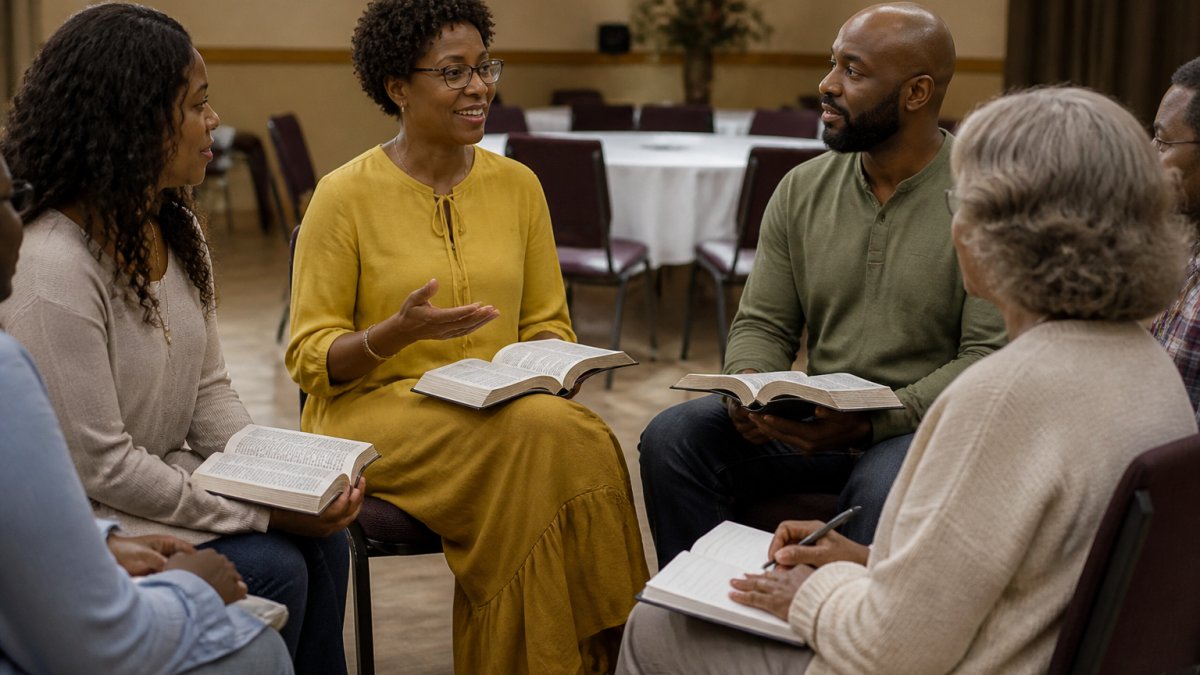
Here is a complete plan you can run next quarter. Each session runs 60 to 75 minutes. The table gives you the spine; the notes below add session objectives, take-home practices, and a simple way to tell whether the group is actually learning.
| Session | Focus | Key Passage | Time | Session Objective |
|---|---|---|---|---|
| 1 | Created in God's image | Genesis 1:26-28 | 60 min | Name one God-given truth about yourself that does not depend on family or achievement |
| 2 | Chosen and adopted | Ephesians 1:3-14 | 65 min | Explain the difference between being chosen and being earned |
| 3 | Called by name | Judges 6:11-24 | 70 min | Identify one place where your self-view and God's view of you disagree |
| 4 | Heritage and faith | Psalm 139 | 70 min | Hold gratitude for your story alongside grief over what was broken |
| 5 | False labels | 2 Corinthians 5:16-21 | 75 min | Replace one false label with a specific scriptural truth |
| 6 | Living it out | 1 Peter 2:9-12 | 60 min | Commit to one practice that reinforces your identity in Christ this month |
Facilitator Notes, Timing, and Materials
Materials: one journal per person, printed passage sheets, a whiteboard, a timer, index cards for one-sentence reflections, extra pens, and a large-print passage sheet.
Standard timing per session (60-75 minutes):
- 10 minutes, welcome, opening prayer, and a one-line check-in
- 15 minutes, reading the passage aloud (twice)
- 25 minutes, guided discussion
Facilitator notes:
- Read the passage aloud twice; some members learn by hearing.
- Ask one question at a time. Silence is fine; count to ten before rescuing the room.
- Redirect the person who dominates with, "Let's hear from someone who hasn't spoken yet."
Take-Home Practices and Follow-Through
A study that ends at the closing prayer rarely changes anything. Give each person one small practice for the week, and open the next session by asking how it went.
- Session 1: Write your name at the top of a page, then write "image of God" beside it. Read it aloud each morning.
- Session 2: List three things you believe you had to earn. Next to each, write "chosen, not earned."
- Session 3: Ask one trusted friend what they see in you that you tend to miss.
Measuring Learning Without Turning It Into a Test
You do not need quizzes. Use three light-touch checkpoints:
- Opening recap (2 minutes). Ask one person to summarize last week's passage in a sentence. If the room goes quiet, revisit the material before moving on.
- Mid-study pulse (Session 3). On index cards, ask, "What is one thing you now believe about yourself that you did not believe in Session 1?" Read them privately and adjust the second half of the study.
- Closing reflection (Session 6). Ask each person to finish, "Because of this study, I will..." Keep the answers and check in a month later.
Adapting the Plan to Your Calendar
The six-session plan fits a quarterly Sunday School term or a summer small-group series. Meeting every other week? Stretch it to twelve weeks and use off weeks for take-home practices. Only four weeks? Combine Sessions 1-2 and 5-6, and keep Sessions 3 and 4 intact, those do the deepest identity work.
The free Study Companion gives you the full leader script for all six sessions, including the take-home practice sheets and the pulse-card prompts.
Identity in Christ Discussion Questions That Get Past the Surface
Good questions do the heavy lifting. Weak questions get polite nods. Strong ones get honesty.
Here are questions that work, grouped by purpose:
Opening questions (5 minutes)
- What is one label people have put on you?
- When do you feel most like yourself?
Scripture questions (15 minutes)
- What does this passage say God believes about you?
- Which phrase is hardest to believe? Why?
Reflection questions (15 minutes)
- Where did your view of yourself come from?
- What would change if you believed this verse tomorrow?
Application questions (10 minutes)
- What is one false label you want to drop this week?
- Who in your life needs to hear this truth?
The best identity in Christ discussion questions move from head to heart to hands: what does the text say, what do I feel, and what will I do?
Youth Group Lessons on Identity: Adapting the Study for Teenagers
Teenagers need the same truth at a faster pace and with more room to talk. Youth group lessons on identity should run 30 to 40 minutes, not 75.
Here is how to adapt the six-session plan:
- Cut the reading time. Read one verse, not a whole chapter.
- Use stories first. Start with Gideon, David, or Esther before doctrine.
- Add movement. Small groups of three work better than one big circle.
Students face identity pressure from social media, peer groups, and family expectations. Name that pressure out loud. Then show them a better mirror.
Mixed-Age and Intergenerational Adaptations
Mixed-age groups are a gift if you plan for them. Pair an older adult with a teenager for reflection time.
Keep language simple enough for the youngest person in the room. Skip the jargon. If a term needs explaining, explain it in a full sentence.
One more tip: let older members lead prayer. It gives them a role and gives younger members a model.
Handling Sensitive Identity Conversations with Care
Identity studies touch family history, race, adoption, abuse, and church wounds. Facilitators need to be ready, not as counselors, but as calm, prepared leaders who know what to say, what not to say, and when to hand off.
Ground Rules to Set in Session One
Read these aloud and post them where the group can see them:
- What is shared here stays here.
- No one has to answer a question.
- We speak for ourselves, not for groups.
What to Say When Someone Discloses Something Hard
A group member may share more than they intended, abuse, a painful adoption, a family rupture. Receive it without probing. Try language like:
- "Thank you for trusting us with that."
- "You don't have to say more. We're glad you're here."
- "Would it be helpful to talk after the session?"
Avoid: "Tell us more," "Have you forgiven them?", "Everything happens for a reason," and any Bible verse offered as a quick fix. Those responses close the door.
Watch out: pressing a member for details about their family or ancestry can reopen real wounds. Let people share at their own pace, and never ask a follow-up question in front of the group.
The Private Follow-Up Protocol
Within twenty-four hours, reach out privately, a text, a call, or a short note: "I'm glad you were with us last night. I'm here if you'd like to talk." Do not repeat what was shared or offer advice unless asked.
Have a referral list ready before the study begins: your pastor, a licensed counselor in your area, and a crisis line.
Handling the Bible's Hard Passages with Honesty
Some texts about lineage and judgment have been misused to wound people. Name that history plainly, then return to the text's own context. If you are unsure of a passage's context, say so and offer to study it together next week, modeling honesty is itself a lesson in identity.
Inclusive Facilitation for Every Participant
Identity work can be harder for some members than others. Plan for that:
- Different reading levels. Offer large-print passage sheets and read every passage aloud so no one is left out.
- Neurodiverse participants. Keep the session structure identical week to week, give the discussion questions in writing, and allow written responses in place of spoken ones.
- People new to Christianity. Define terms like "adoption," "justification," and "new creation" in a full sentence the first time you use them. Never assume a church background.
When to Pause the Study
If a session becomes a crisis, stop the lesson. Close in prayer, dismiss the group, and follow up privately. A study can wait a week; a person in pain cannot.
Get the Free Study Companion to Start Your First Session
You don't need to build this from scratch. The free teaching resources include a downloadable sample chapter plus the full Study Companion and Discussion Guide, ready for Sunday School classes and small groups. If you want to know who wrote the material before you lead with it, read about June Conway, a retired educator and Sunday School teacher with more than four decades of public service.
For a deeper journal-based approach, the Spiritual Lineage Bible Study Journal Guide walks through identity in Scripture one passage at a time. And when you're ready to commit to the full six sessions, explore the full collection to see the journal and toolkit the plan is built around.
Leading a group through identity work takes courage. Some sessions will get quiet. Some will get honest. That is the point.
June Conway built Sacred Lineage and The Hebrew Heritage Toolkit for exactly this work: a 30-day guided journal for personal reflection, a research guide that examines Scripture, history, and DNA ancestry evidence, and a complete Study Companion with discussion questions for groups.
Get started with June Conway and give your group the study that answers the question they've been carrying all along.
Frequently Asked Questions
What does the Bible say about spiritual identity?
Scripture roots identity in God's character and action rather than in achievement or ancestry alone. Genesis 1:27 says people are made in God's image, and Ephesians 1:4-5 describes believers as chosen and adopted. Passages like 1 Peter 2:9 call them a chosen people and a royal priesthood. A spiritual identity Bible study helps groups trace these threads across the Old and New Testaments so members see that their worth and purpose come from God, not from what others say about them.
How do you lead a group Bible study on identity in Christ?
Start with a clear session plan: an opening question, a short passage, guided reflection, and discussion. Keep groups to 8-12 people so everyone can speak. Use identity in Christ discussion questions that move from head knowledge to personal application, and model vulnerability by sharing your own answers first. Build in quiet reflection time for introverts, and close each session with one concrete step members can practice during the week.
How many sessions should an identity Bible study include?
Six sessions works well for most groups. That gives you one session each for creation and God's character, personal worth, purpose and calling, false identities, biblical character examples like Gideon, and application to daily life. A six-week study fits a typical quarter in many Sunday School calendars and leaves room for a review week. Shorter groups can run three sessions by combining topics, while youth groups may prefer eight shorter meetings.
What activities help a group explore biblical identity?
Try a mirror exercise where members write down what God says about them from selected verses, then compare it with labels they have carried. Use biblical character studies, such as Gideon in Judges 6, to show how God renames and redirects people. Add a journaling prompt before discussion, a small-group share-back, and a closing prayer where members speak one truth from Scripture over each other. These activities work for adults, teenagers, and mixed-age groups.