 How-to
How to Connect Ancestry to Scripture: A Study Guide
Table of Contents
- What Does the Bible Say About Ancestry?
- Step 1: Gather Your Family Records and DNA Evidence
- Step 2: Study the Genealogy of Jesus in Matthew
- Step 3: Compare Your Family Tree with Biblical Genealogies
- Step 4: Connect Ancestry to Scripture Through Reflection and Study
- Common Mistakes When Connecting Ancestry to Scripture
- Conclusion: Building a Faith-Centered Family History
- Frequently Asked Questions
Last Updated: October 7, 2026
What Does the Bible Say About Ancestry?
The Bible treats ancestry as more than a list of names. Scripture uses family lines to show God's promises moving through real people across real generations.
Biblical genealogy is the record of family descent found throughout Scripture, from the generations in Genesis to the lineage of Jesus in the Gospels. These lists were not decoration. They established identity, land rights, and priestly roles in ancient Israel.
The Old Testament opens with long family records for a reason. Genesis traces humanity from Adam through Noah to Abraham. Later books trace tribes, clans, and households.
The New Testament picks up the same thread. Matthew 1 opens with "the genealogy of Jesus Christ," and Luke 3 offers a second line. Both writers wanted readers to see Jesus rooted in a real family history.
So what does the Bible say about ancestry? It says ancestry matters. It says God works through families. And it invites you to read your own family story in light of that larger narrative.
Step 1: Gather Your Family Records and DNA Evidence
Start with what you already have. Birth certificates, family Bibles, photo albums, and oral histories are the foundation of any ancestry project.
Here is a simple checklist before you begin:
- Collect birth, marriage, and death records from living relatives
- Photograph or scan old family photos and documents
- Write down family stories before they are lost
- Note names, dates, and places in one master list
- Take a DNA test if you want haplogroup or regional data
- Save everything in a folder, physical or digital
A common mistake is skipping the family interviews. Older relatives often hold details no record contains. Talk to them first.
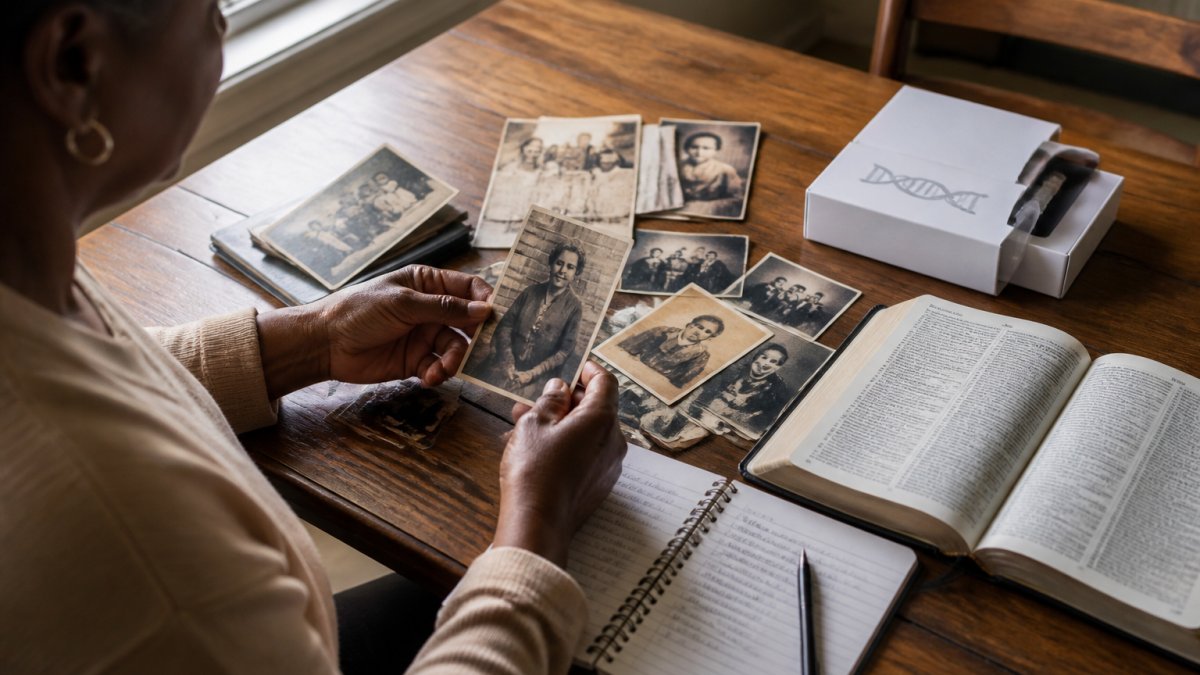
DNA results give you clues, not conclusions. They point to regions and possible ethnic roots. Treat them as one piece of evidence among many.
Step 2: Study the Genealogy of Jesus in Matthew
The genealogy of Jesus in Matthew is the best starting point for biblical genealogy study. It runs from Abraham to Jesus in three sets of fourteen generations.
Read Matthew 1:1-17 slowly. Notice the structure:
- Verses 2-6: Abraham to David
- Verses 7-11: David to the exile
- Verses 12-16: The exile to Jesus
Matthew includes women in the line, which was unusual for the time. Tamar, Rahab, Ruth, and Bathsheba all appear. That detail carries meaning.
Then compare with Luke 3:23-38. Luke traces the line backward through David to Adam. The two lists differ, and scholars have debated why for centuries.
A practical approach is to read both accounts, note the shared names, and mark where they diverge. This trains your eye to read genealogies carefully.
Step 3: Compare Your Family Tree with Biblical Genealogies
Lay your family tree beside the biblical text. Do not expect a match. Expect patterns, themes, and questions. This is the step most guides skip, and it is where the real study happens.
Here is a repeatable method you can run on any ancestor, in about twenty minutes:
- Pick one person and one fact. Choose a single ancestor and a single documented detail, a birth year, a migration, a marriage, an occupation.
- Choose one passage. Read a genealogy or family narrative: Genesis 5, Genesis 10, Genesis 11:27-32, Ruth 4:18-22, 1 Chronicles 1-9, Ezra 2, Matthew 1:1-17, or Luke 3:23-38.
- Name the genre. Ask what the passage is doing. Is it a linear line (father to son), a segmented line (three blocks of names, as in Matthew), or a selective line that skips generations? The answer changes how you read it.
- Write one parallel and one contrast. One way your family's story echoes the passage, and one way it does not. The contrast is often the more honest and more interesting half.
- Record the source. Note the document, the date you accessed it, and the repository. Unsourced comparisons cannot be checked later.
A worked example. Suppose your records show a great-grandfather who left a farming village in 1918 and never returned. Read Genesis 12:1-9, where Abram leaves his father's house for a land he has not seen. The parallel is departure and trust. The contrast is that Abram had a promise and a destination; your ancestor may have had neither.
A second example. Suppose a family Bible lists four children, but you can document only two. Read Matthew 1:1-17, which compresses roughly two thousand years into forty-two named generations and deliberately omits kings.
Here is how the two kinds of records line up, and what each can and cannot tell you:
| What You Have | What Scripture Offers | A Sound Use | A Use to Avoid |
|---|---|---|---|
| Names, dates, places | Named generations in Matthew 1 | Compare name meanings and naming customs | Claiming an exact match to a biblical name |
| Regional DNA estimates | Tribal and national lines in Genesis 10 | Study migration and settlement themes | Treating a region as a tribe |
| Oral family stories | Covenant promises to Abraham | Connect your story to a larger narrative of promise | Asserting a bloodline covenant |
| Migration records | Exile and return in Ezra and Nehemiah | Frame movement and resettlement | Dating biblical events from your own records |
| Parish or county registers | Census-style lists in Ezra 2 | Learn how ancient scribes organized households | Assuming identical record-keeping standards |
Three rules keep this step honest:
- Match genre to genre. Compare a legal record to a legal-style list, and a family story to a narrative. Do not compare a DNA estimate to a covenant promise.
- Match scale to scale. A single ancestor is not a nation. Compare one person to one person, or one family line to one family line.
- Write the uncertainty down. If you cannot tell whether a name is the same person, say so in your notes. Future you will thank present you.
You are not trying to prove a specific biblical identity. You are trying to read your family history with Scripture in hand. That difference matters, and it is what separates a devotional exercise from a disciplined one.
Step 4: Connect Ancestry to Scripture Through Reflection and Study
Reflection turns records into meaning. Set aside regular time to read, journal, and pray over what you find. The method below works for one person or a group of twelve.
The weekly rhythm. Pick one ancestor and one passage each week. Read the passage aloud twice. Then write, in this order:
- One fact you can document about the ancestor
- One sentence linking that fact to the passage
- One question the passage raises that you cannot answer
- One prayer for a living member of your family
Repeat for four weeks. Patterns emerge around week three, usually in the questions rather than the answers.
Reflection prompts that go past the surface. Most guides stop at "how do you feel?" These push further:
- What did this ancestor leave behind, and what did they carry with them? Compare with Genesis 12:1-9.
- Which names in your family repeat across generations? Compare with the naming patterns in Genesis 5 and Luke 1:59-63.
- Where does your family record go silent? Read the gaps in 1 Chronicles 1-9 and ask what selective memory does for a community.
- Who in your family is not in the records, the unmarried, the adopted, the estranged? Read Ruth 4:18-22 and note who is named and who is not.
- What promise or covenant shaped your family's decisions? Compare with the covenant language in Genesis 17 and 2 Samuel 7.
- If you could ask one ancestor one question about their faith, what would it be, and which passage would you read with them?
For groups and intergenerational study. A 45-minute session works well with this structure:
- Opening (5 min): Read the passage aloud.
- Sharing (15 min): Each person offers one documented family fact, no speculation required.
- Study (15 min): Work through two prompts above as a group.
- Closing (10 min): Each person names one ancestor, living or deceased, and one prayer.
Two ground rules keep the room safe. First, no one has to share anything they have not verified. Second, no one claims a biblical identity for another person's family line.
A note on the limits. Biblical genealogies are frequently selective, and some use symbolic numbers or structured groupings, Matthew's three sets of fourteen is the clearest example. Ancient family lines served legal, land, and priestly purposes, not the archival purposes we expect today.
If you want a structured path, June Conway's Sacred Lineage journal follows this rhythm across 30 days of guided reflection. The Hebrew Heritage Toolkit adds a research guide for deeper study, and the Study Companion & Discussion Guide adapts the prompts above for Sunday School and small group settings.
Common Mistakes When Connecting Ancestry to Scripture
Most people make the same errors early on. Here are the ones we see most often.
Treating DNA as a verdict. DNA evidence gives you probabilities and regions. It does not name your ancestors from biblical times.
Reading genealogies as modern family trees. Biblical genealogies often skip generations or use symbolic numbers. They serve theological purposes, not just record-keeping.
Skipping the historical context. Ancient family lines tied to land, tribe, and covenant. Read them in that world, not ours.
Claiming a specific biblical identity. Scripture does not ask you to prove you descend from a particular tribe. It asks you to live faithfully.
Ignoring the limits of the record. Records are incomplete. Uncertainty is normal. Name it honestly in your study.
A thoughtful study admits what it does not know. That honesty builds trust with your group and with yourself.
Conclusion: Building a Faith-Centered Family History
Building a faith-centered family history takes patience and humility. The records will have gaps. The DNA results will raise more questions than answers. That is part of the work.
If you want a structured path, June Conway offers tools built for this exact task. The Sacred Lineage journal gives you 30 days of guided reflection. The Hebrew Heritage Toolkit provides a full research guide. The Study Companion & Discussion Guide supports Sunday School classes and small groups.
Get started with June Conway and connect your heritage to the biblical story with confidence.
Frequently Asked Questions
How can I connect my family history to the Bible?
Start by gathering family records, oral histories, and DNA results if available. Then study biblical genealogies like Matthew 1 and Luke 3 to understand how lineage establishes identity and fulfills covenant promises. Use a structured journal to reflect on parallels between your family's story and biblical themes. Remember that the goal is spiritual connection, not proving a specific biblical identity.
Can DNA results prove a connection to a biblical people?
DNA testing can reveal genetic ancestry and haplogroups, but it cannot prove a direct link to biblical figures or ancient Israelite populations. Genetic science has limits, and biblical genealogies are theological documents, not modern pedigree charts. Use DNA as one piece of evidence alongside historical records and Scripture, and avoid making definitive claims about biblical identity based solely on genetics.
What can biblical genealogies teach us about heritage?
Biblical genealogies like those in Genesis, Matthew, and Luke show that God works through families and generations to fulfill promises. They establish legal and covenantal lines, such as Jesus' descent from Abraham and David. Studying them helps you see your own family history as part of a larger story of faith, and they model how to trace God's faithfulness across time.
How should I read the genealogy of Jesus in Matthew?
Read Matthew 1 as a deliberate theological statement. Matthew structures the genealogy in three sets of fourteen generations to show Jesus as the promised Messiah, the son of David and Abraham. Notice the inclusion of women like Tamar, Rahab, Ruth, and Bathsheba, which signals that God's grace extends beyond conventional boundaries. Compare it with Luke's genealogy to see different emphases and audiences.