 How-to
How to Connect Faith to Ancestral History
Last Updated: November 22, 2026
Quick Summary
Connect faith to ancestral history by building a documented family tree first, then turning one verified fact into a faith practice through reflection, Scripture, and prayer. Use a five-move sequence: pick one documented fact, ask three questions, read one matching Scripture passage, pray gratitude and petition, and record the outcome.
- Listen to the oldest living relatives before opening a genealogy website or ordering a DNA kit.
- Attach a source to every fact and mark gaps clearly instead of guessing.
- Match Scripture by theme, not by person, and read the passage twice.
- Honor ancestors through gratitude and remembrance while keeping worship for God alone.
- Name the type of record gap before researching it, since each kind calls for a different response.
Table of Contents
- Step 1: Gather What Your Family Already Knows
- Step 2: Build a Documented Family Tree Before You Interpret It
- What Does God Say About Ancestry?
- Step 3: How to Connect With Your Ancestors Spiritually
- Step 4: How to Honor Ancestors Without Worshiping Them
- When Your Religious Ancestry Is Mixed, Unknown, or Disrupted
- Setting Ethical and Emotional Boundaries in Ancestral Practice
- Start Your Sacred Lineage Study With June Conway's Free Resources
- Frequently Asked Questions
Step 1: Gather What Your Family Already Knows
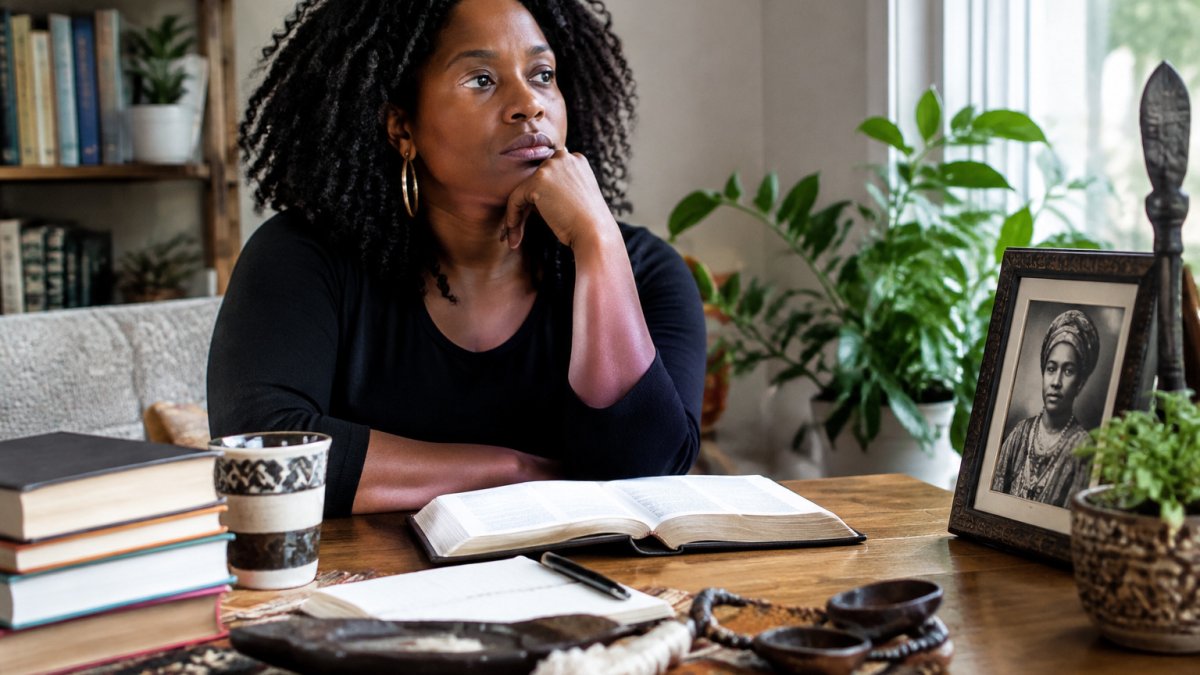
Learning how to connect faith to ancestral history starts with listening before you research, and that listening is the first act of ancestral history.
Treat family history as a sacred practice, not a data-entry chore. The first step is the one most people skip.
Start with the oldest living relatives. Ask open questions and let them talk.
- Full names, nicknames, and name changes
- Birthplaces, churches, and cemeteries
- Migration routes and the towns families left
- Family Bibles, photos, and letters
- Recipes, songs, and prayers passed down
Write down what you hear, even the parts that seem small. A church name or a county can unlock years of research later.
Watch out: memory is not a record. Treat every story as a lead to confirm, not a fact. A relative's recollection of a date or name is a starting point, and official documents are where you verify it.
Keep a simple notebook or a shared document. Label each entry with who told you and when. That habit will serve you well in the next step.
Step 2: Build a Documented Family Tree Before You Interpret It
A documented family tree is a map of names, dates, and places backed by sources, and it must come before any spiritual interpretation. Build the facts first, then ask what they mean.
This is where most well-meaning guides get it wrong. They jump straight to meaning and skip the paperwork. That order produces conclusions you cannot defend.
Here is a simple sequence to follow:
- Record each person with a birth, marriage, and death date where you can find one
- Attach a source to every fact: a census record, a certificate, a church register
- Mark gaps clearly instead of guessing
- Separate confirmed facts from family lore in your notes
For a deeper walkthrough of source evaluation and biblical genealogy, see our guide on how to study biblical genealogy effectively. It explains how to weigh records and avoid the traps that trip up beginners.
Reliable genealogy depends on good sources. The National Archives genealogy resources explain how to request federal records, including census and military files, that often hold the answers family stories leave out.
Treat your tree as a working draft. It will change as you find records, and that is normal.
What Does God Say About Ancestry?
Scripture treats ancestry as a real part of identity, not a footnote. The Bible is full of genealogies, and it uses them to anchor people in a story larger than themselves.
Consider how often the Bible names ancestors. Matthew opens with a genealogy. The Old Testament traces lineages to establish inheritance and covenant. These lists are not filler; they tell readers where they came from and why it matters.
A few themes stand out:
- Heritage as gift: Psalm 127 calls children a heritage from the Lord
- Remembrance as duty: Israel is repeatedly told to remember what God did for their ancestors
- Identity and calling: lineage shapes how biblical figures understand their place in God's plan
So what does God say about ancestry? The Bible honors it while keeping worship directed at God alone. Your ancestors are part of your story, and their faith, struggles, and choices can teach you. They are not the object of your devotion.
That distinction matters for everything that follows.
Step 3: How to Connect With Your Ancestors Spiritually
Connecting with your ancestors spiritually means using reflection, prayer, and study to draw wisdom from your family's story while keeping God at the center.

Most guides stop at "pray and journal." That advice is true but too vague to follow.
Move 2: Ask three questions of the fact. What did this person have to trust God for in this moment? What did they not know that I now know? What did their choice cost them? These questions move you from data to discipleship without speculating beyond the record.
Move 3: Read one Scripture passage alongside it. Match the theme, not the person.
Move 4: Pray one specific prayer of gratitude and one of petition. Gratitude names what their life made possible for you.
Move 5: Record the outcome. Write one line about what changed in your thinking or behavior.
Here is a worked example. Suppose a census record shows your great-grandfather listed as a coal miner in 1920, living in a company town.
For a structured tool to begin this reflection, our Spiritual Lineage Bible Study Journal Guide walks through a 30-day rhythm of Scripture and family history.
Watch out: reflection can drift into speculation.
Pairing a documented tree with this five-move sequence can turn a hobby into a practice. You are not just collecting names.
The article lays out a repeatable five-move sequence that turns one documented fact into a faith practice.
| Move | What to do | Detail |
|---|---|---|
| Move 1 | Pick one documented fact | A census occupation, migration year, church record, or marriage date |
| Move 2 | Ask three questions of the fact | What they trusted God for, what they did not know, what it cost |
| Move 3 | Read one Scripture passage alongside it | Match the theme, not the person; read it twice |
| Move 4 | Pray gratitude and petition | Two sentences: thank God, ask for the same virtue |
| Move 5 | Record the outcome | One line on what changed in thinking or behavior |
Step 4: How to Honor Ancestors Without Worshiping Them
Honoring ancestors is different from worshiping them, and the line is clearer than people fear. Honor means gratitude and remembrance. Worship belongs to God alone.
So how do you honor ancestors without worshiping them? Keep the focus on thanksgiving, storytelling, and faith. Avoid anything that treats ancestors as mediators or sources of power.
Practical ways to honor your ancestors:
- Share their stories at family gatherings
- Cook a dish they were known for and tell the story behind it
- Visit graves and clean them as an act of respect
- Name children or keepsakes after them
- Give to causes that mattered to them
These acts build intergenerational connection without crossing into devotion. Many families find that a simple memorial meal or a moment of silence before a holiday dinner does the work.
The key is intention. If the practice points you toward gratitude and toward God, it honors well.
When Your Religious Ancestry Is Mixed, Unknown, or Disrupted
Not everyone has a clean lineage to trace, and that is not a failure. Many families face records destroyed by slavery, migration, or conflict.
Here is how to proceed with care, in order.
1. Name the type of gap before you research it. Gaps fall into four kinds, and each calls for a different response:
- Destroyed records: courthouse fires, war losses, and records never created for enslaved people. Response: look for substitute records, tax lists, church minutes, Freedmen's Bureau records, plantation ledgers, and oral histories.
- Disrupted records: migration, name changes, and border shifts. Response: trace the family forward and backward through census decades and naturalization papers rather than searching one name.
- Unknown records: adoption, donor conception, or a parent who left no paper trail. Response: use DNA matches and request non-identifying information from the agency or court that handled the placement, following that agency's own rules.
- Mixed traditions: a Catholic grandmother, a Protestant grandfather, a Jewish great-grandparent, or a convert in any generation. Response: research each tradition separately rather than blending them into one story.
**2.
**3.
4. Reflect honestly when beliefs differ. A useful pattern is to pray in two directions: gratitude for the faith you inherited, and honesty about where you disagree.
5. When records stop, shift from names to themes. If the paper trail ends at a certain generation, you can still reflect on what that generation faced: migration, famine, war, or forced labor.
For readers wrestling with difficult passages tied to ancestry, our explanation of the Deuteronomy 28 slave verses offers context for one of the most sensitive texts in this conversation.
Watch out: DNA results and adoption records can surface information that living relatives did not consent to share.
Setting Ethical and Emotional Boundaries in Ancestral Practice
Ancestral research can surface hard truths, and boundaries protect you while you work. Set them before you start, not after a difficult discovery.
Ethical and emotional boundaries matter for two reasons. First, living relatives have a right to privacy about their own stories. Second, you need room to process what you find.
A simple boundary checklist:
- Ask relatives before publishing their stories or photos
- Decide in advance how much time you will spend researching each week
- Keep a trusted friend or pastor to talk with when findings are heavy
- Separate your faith convictions from other people's interpretations of your family
- Stop and rest when the work starts to feel like an obligation
A common mistake is treating a DNA result or a record as a verdict on identity. It is information, not a final answer. Give yourself permission to sit with it.
When in doubt, slow down. The work is meant to build you up, not wear you down.
Start Your Sacred Lineage Study With June Conway's Free Resources
The gap between a pile of records and a living faith practice is where many people stall. You have the names, the stories, and the questions, but no structure to bring them together.
June Conway's resources are designed to offer that structure. The Sacred Lineage Bible study journal offers a 30-day guided path for personal reflection. The Hebrew Heritage Toolkit is a research guide that examines biblical prophecy and historical evidence. A complete Study Companion & Discussion Guide supports Sunday School classes and small groups.
These materials combine Scripture, history, and DNA analysis into one path. They are designed for personal reading and for group study.
Get started with June Conway's free resources to explore your family's story.
Frequently Asked Questions
How do I connect spiritually with my ancestors?
Start with documented research, not guesswork. Write down names, dates, and places from living relatives, then verify them with records like census entries and birth certificates. Once you have a confirmed name, set aside time to read that person's story alongside Scripture, pray for the generations after them, and journal what you notice. The spiritual connection grows from knowing the actual person, not from a general idea of ancestry. June Conway's Sacred Lineage journal structures this into 30 days of guided reflection.
Can I believe in God and still honor my ancestors?
Yes. Honoring ancestors and worshiping them are different acts. Honor looks like researching a great-grandmother's life, saying her name aloud, recording her story for your children, and expressing gratitude for what she endured. Worship belongs to God alone. Keep prayer directed to God, and let remembrance of family members sit inside that framework. Many church traditions practice exactly this through memorial services, family history Sundays, and heritage celebrations.
How can DNA results help me understand my ancestral history?
DNA testing can confirm or challenge what paper records suggest, especially when records were destroyed or never created. A haplogroup result traces one deep maternal or paternal line and can point to regions of origin. Treat it as a research clue, not a conclusion: test companies update their reference populations over time, so a region estimate can shift. Pair DNA findings with documented genealogy before drawing faith conclusions. June Conway's Hebrew Heritage Toolkit examines historical evidence and DNA ancestry data.
What if I don't know my family's religious background?
Unknown or disrupted ancestry is common, particularly where families were separated by slavery, migration, or estrangement. You do not need a complete record to begin. Research what you can document, name the gaps honestly in your journal, and reflect on how faith was passed down even when the details are missing. Oral history from living relatives often fills gaps that written records cannot. Start with one question to one relative this week.